
Generate large primes.
Right on your PC.
Choose a range. Generate and save a list of primes.
This Windows app creates large datasets locally—even lists that would be cumbersome to download.
Windows 10 / 11 · x64 · English / Japanese
Microsoft Store · Japan price: ¥980 · 7-day free trial
Just press Generate.
- 01Choose a rangeExplore near large values, too
- 02Generate locallyEstimate space, stop and resume
- 03Save in your preferred format
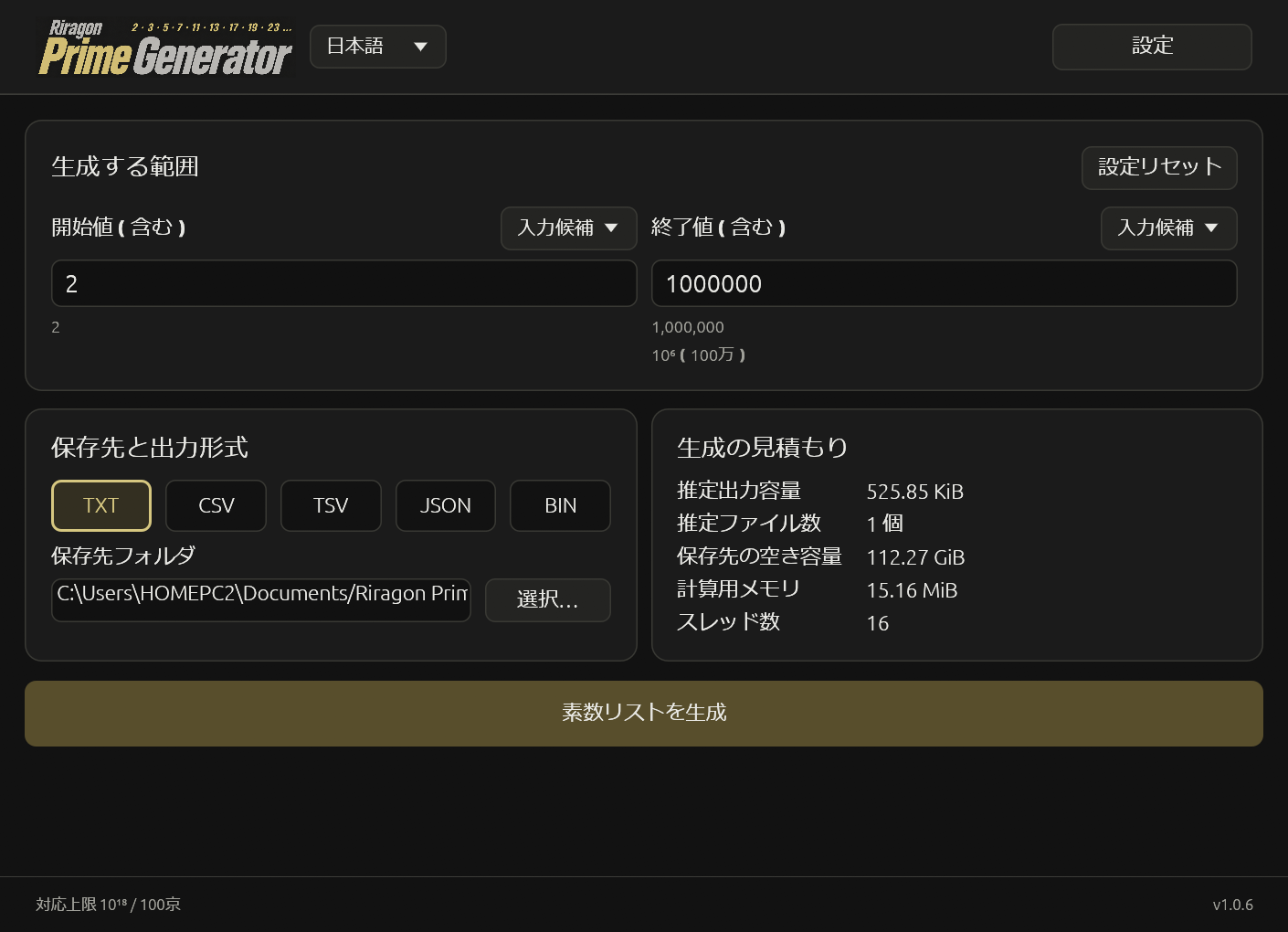
Generate a massive prime list
with one click.
Measured on the development PC (Intel Core i9-9900K): range 2–10 billion, BIN format, including storage integrity checks. Time varies with the range, format and PC.
Inside a list this large,
you might spot a pattern you have never seen.
Count the digits. Compare the gaps. Rearrange the numbers.
A plain list can reveal surprising patterns when you look at it a different way.

About 25% each.
Yet less likely to repeat.
Look closer at the numbers.
Something unexpected appears.
Primes greater than 5 end in 1, 3, 7 or 9. Count those digits individually and they appear almost equally often. Look at their order, though, and a bias emerges. Try changing the selected digit.
Which digit comes next?
After a prime ending in 1, the next also ends in 1 only 16.38% of the time. That is below the 25% baseline for four equally likely independent choices.
Calculated from the 78,495 primes greater than 5 and up to 1 million. The 78,494 consecutive pairs are grouped by the previous prime’s last digit.
Equal frequencies mean a random order, right?
Equal frequencies do not imply that neighboring digits are independent. Four equally likely independent choices would repeat the same digit 25% of the time. In this prime sample, all same-ending pairs together account for only about 15.35%.
Repeats do occur: 181 and 191 are consecutive primes that both end in 1. “Less likely to repeat” describes a statistical bias, not a rule that predicts every next prime.
The 25% share is a limit approached as the range grows; a finite sample differs slightly. Behind the question “why?” lie both proven results and ongoing research. Explore the explanation →
A different way to see the numbers.
Order, gaps and arrangement. Change your viewpoint, and another surprise comes into focus.
Another prime, just two steps away.
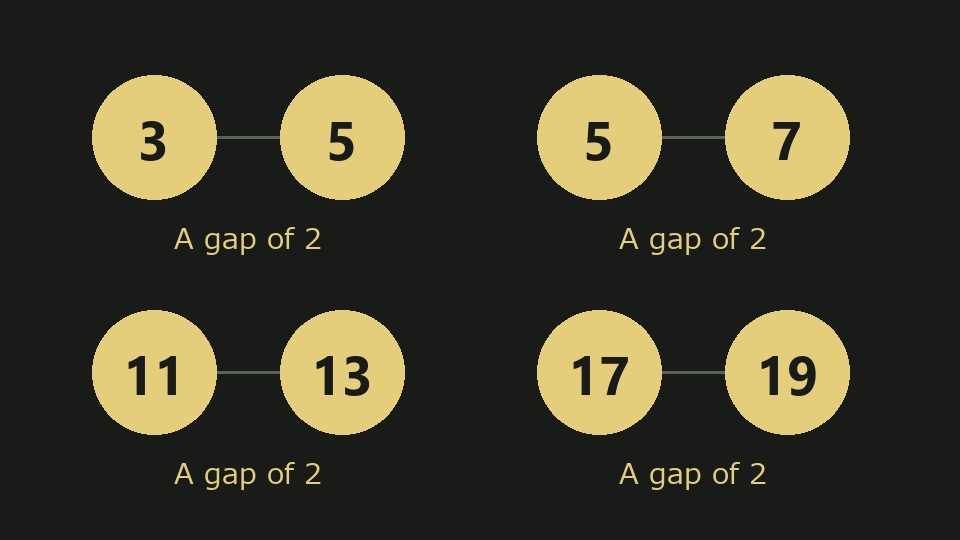
11 and 13. 17 and 19. Primes that differ by 2 are called twin primes: one integer sits between them. There are eight pairs up to 100. The number 5 belongs to two pairs, with 3 and with 7.
Do these pairs go on forever?
Whether there are infinitely many twin primes remains an open problem. Even a pattern easy to spot in small numbers can conceal a question mathematicians are still trying to answer. The twin prime conjecture
Suddenly, no primes in sight.
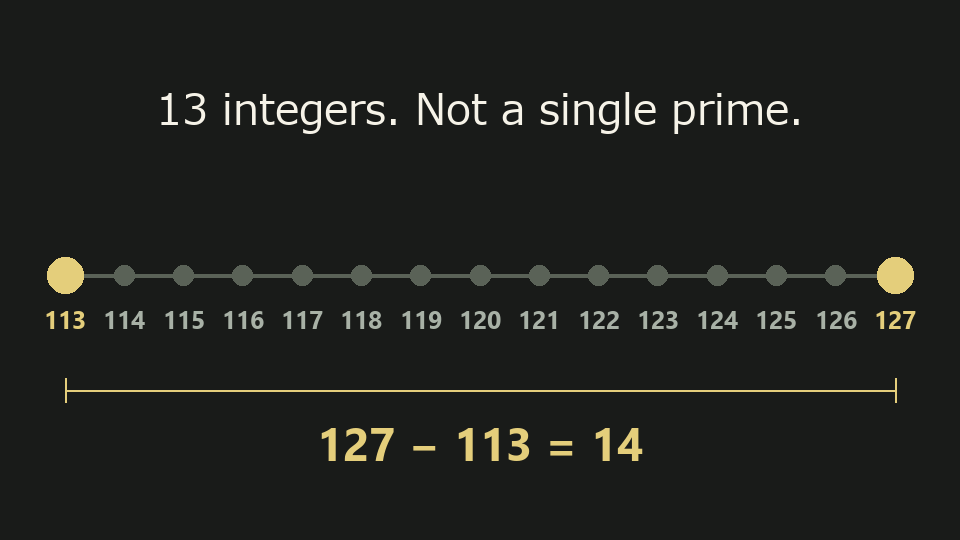
After 113 comes 127, with 13 nonprime integers in between. 119 is 7×17; 121 is 11×11. Being odd is not enough. Sometimes primes crowd together, and sometimes they leave a long gap.
Can a gap be even longer?
Arbitrarily long runs without a prime exist. Let N = 1×2×…×10. Then N+2 is divisible by 2, N+3 by 3, and so on through N+10. Extend the product and you can make the run as long as you like.
Rearrange the numbers. Find a pattern.
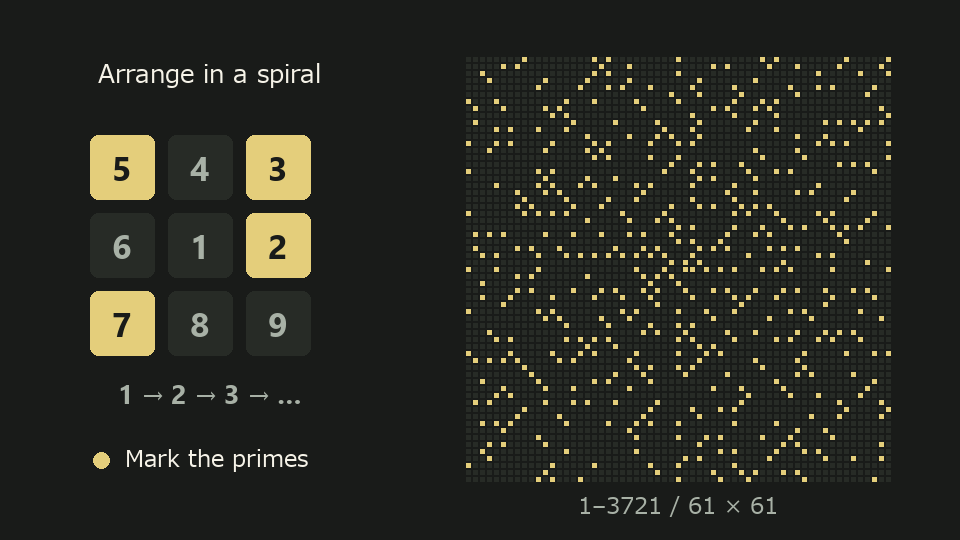
Start with 1 in the center and arrange the integers in a spiral. Mark only the primes, and diagonal streaks appear. This is the Ulam spiral. A bias hard to notice in a list becomes a visible pattern.
Is every number along a streak prime?
No. Even the apparent streaks contain nonprime positions. The pattern looks orderly, yet gaps remain. That is part of what makes it fascinating. How the spiral works
Larger numbers, fewer encounters.
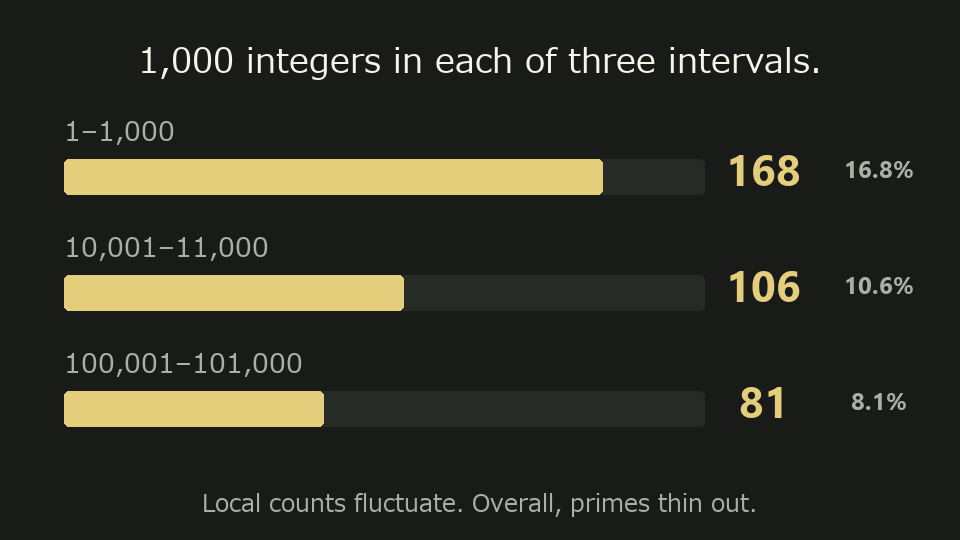
Each interval contains 1,000 integers, but the prime counts here are 168, 106 and 81. Overall, primes become sparser as the numbers grow. They never run out, though: there are infinitely many.
Does every next interval have fewer primes?
No. Counts in individual intervals rise and fall. The broad trend and local fluctuations are different things; the decrease is not always smooth. The distribution of primes
A formula with a 40-prime streak.
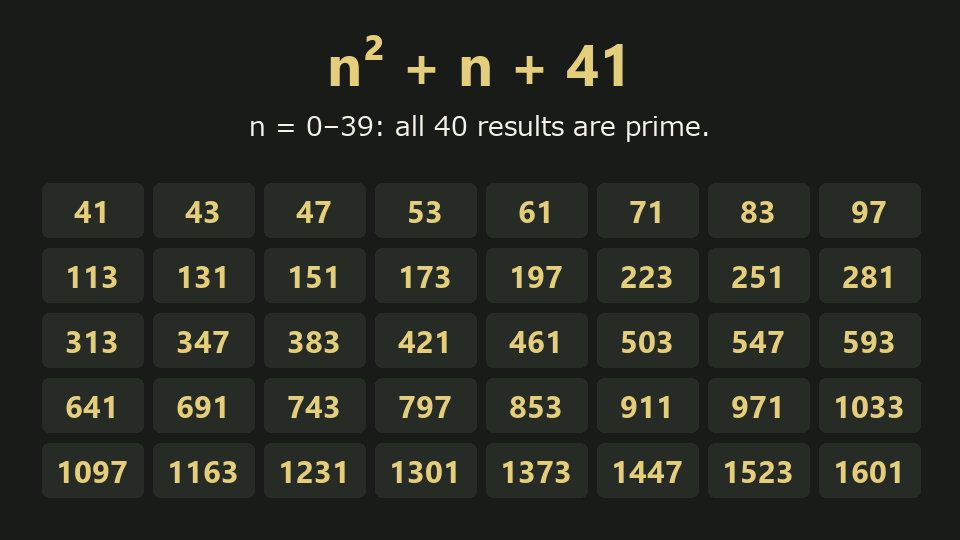
Put 0, 1, 2… into n²+n+41 and out come 41, 43, 47, 53…. Every result for n = 0 through 39 is prime. Euler’s famous formula makes it tempting to think the streak might last forever.
What happens at 40?
40²+40+41 = 1681 = 41×41. The streak ends. A single number shows the difference between a pattern that works many times and a statement that is always true. About this formula
The same, read either way.
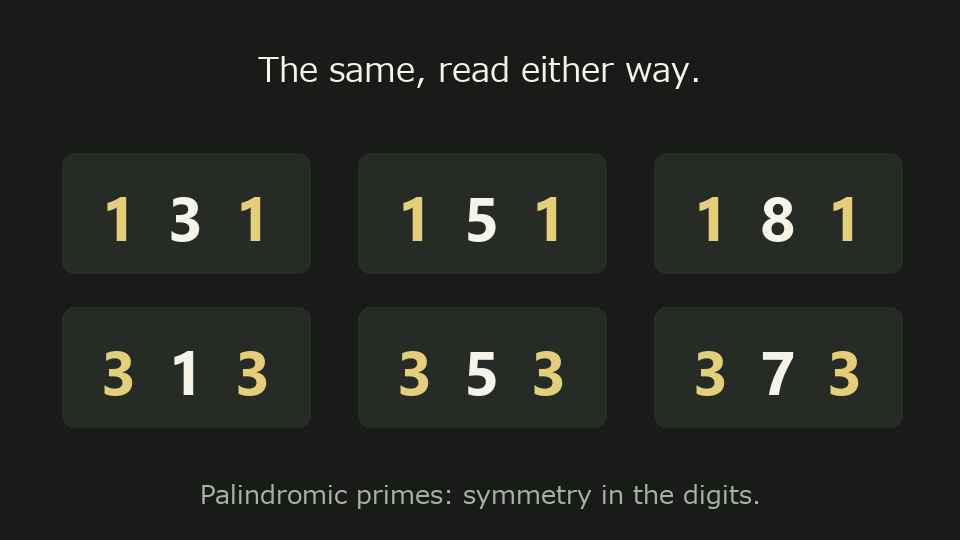
131 and 313 read the same backwards. Numbers with this symmetry are palindromes; those that are also prime are palindromic primes. Here, divisibility and the shape of the digits meet.
Is 121 a palindromic prime, too?
It is a palindrome, but 121 = 11×11, so it is not prime. Every decimal palindrome with an even number of digits is divisible by 11. The only prime among them is 11 itself. Why 11 is special

Big lists can be hard to download. Create yours locally.
Set range endpoints up to 10¹⁸. Explore a small interval near a large value, or generate an entire range you need. Save as TXT, CSV, TSV, JSON or BIN, then analyze the numbers in a spreadsheet or your own program.
For Windows x64, with English and Japanese interfaces. Features shown are based on development version 1.0.6. Check Microsoft Store for the available version, local price and trial terms.
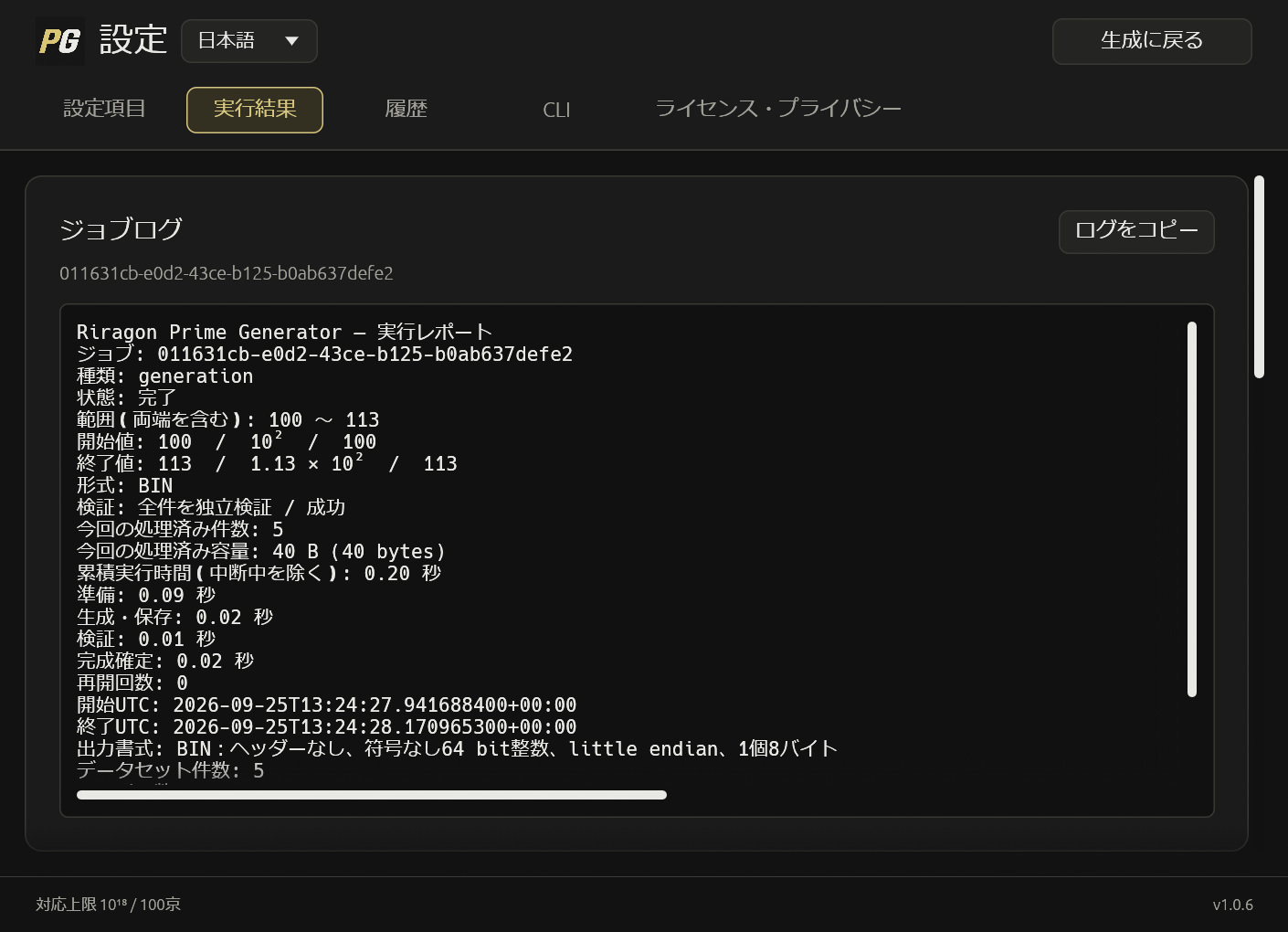
Keep large datasets manageable.
Estimate the output size and file count before starting, and check available disk space. Split large outputs into files and resume interrupted jobs. Time and storage requirements depend on your range and PC.
Storage integrity checks examine corruption, format, order and counts. Full independent verification compares the entire list against primes calculated by a separate implementation. Settings and results can be saved in a report.
Generate and analyze with CLI or AI.
The command-line interface lets you control the app with commands. The included riragon-prime.exe accepts a prime count as well as a range. In Settings → CLI, copy instructions for an AI that can run commands on your PC.
Analyze saved data with gaps for prime gaps, density for counts by interval, and probe for primes around a chosen value. See the guide for generation and analysis steps.
Need a hand?
Find answers to common questions,
or get in touch by email.
Start with a free 7-day trial.
Japan price¥980Microsoft Store
Generate and save prime lists on your own PC.
Check the Store for pricing in your region.